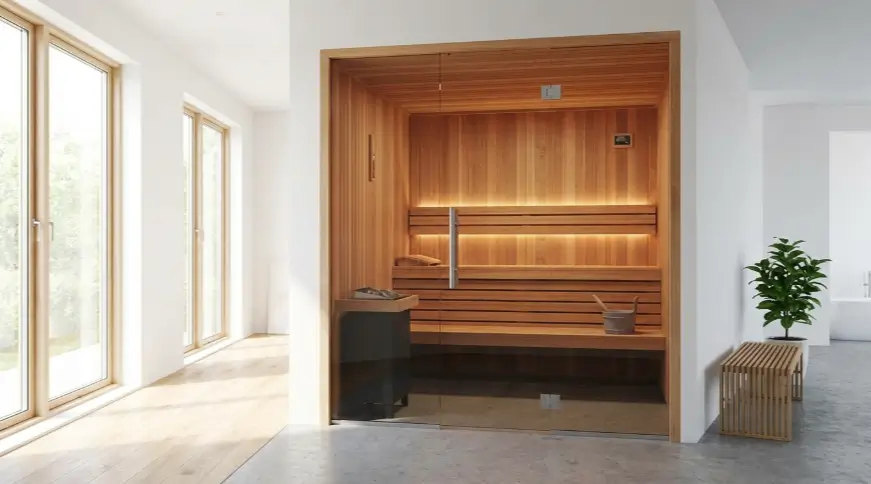
Electric heaters run almost every indoor sauna built inside a house, and for good reason: a wood-fired heater needs a stovepipe and chimney routed through finished ceilings or walls to reach outside air, a project most homeowners are not set up to take on. A small electric heater sized for an interior cabin costs $400 to $1,200 to buy and 35 to 75 cents per session to run, while a wood-fired setup indoors, when it’s done at all, typically adds $1,500 to $4,000 or more in chimney work alone once fire clearances and finished-wall penetrations are factored in.
Why Does Wood Heat Rarely Show Up in Indoor Saunas?
A wood-fired heater has to vent combustion byproducts somewhere, and outdoors that means a stovepipe running straight up through open air to a chimney cap above the roofline, a fairly contained job. Indoors, the same stovepipe has to pass through a finished ceiling, an attic space, and a roof, maintaining fire-code clearance from framing, insulation, and drywall the entire way. That’s a legitimate construction project involving a roofing contractor as much as a sauna installer, which is why the overwhelming majority of indoor sauna installs, especially in a basement, garage, or spare room, use electric heat instead.
What Does an Electric Heater Actually Cost for an Interior Room?
A traditional electric heater sized for a small two-person interior cabin, typically 4.5 to 6 kW, runs $400 to $1,200 for the unit. If your room already has a 240-volt circuit nearby, an electrician might charge $300 to $600 to make the connection. If you need an entirely new circuit from your home’s main panel, that climbs to $600 to $1,500 depending on distance and whether the run passes through finished walls. No venting is required at all, which keeps an electric install contained to electrical work rather than touching your roof or exterior walls the way wood heat would.
What Would a Wood-Fired Setup Actually Involve Indoors?
If you’re set on wood heat specifically, for the ritual or because you have a reliable free wood source, the realistic path indoors is a basement location with existing chimney access, or a garage conversion where routing a new chimney is more straightforward than cutting through a finished second story. Even then, budget $1,500 to $4,000 for the stovepipe, chimney, and roof penetration alone, on top of a wood-fired heater itself running $800 to $2,500. Fire clearance requirements from combustible framing are non-negotiable and typically require permitted work, not a DIY afternoon project, which is the main reason this option stays rare inside finished homes.
See also: The Role of Crypto in the Digital Economy
What Does Each Option Cost Per Session Going Forward?
Electric heaters draw grid power the entire session, working out to roughly 35 to 75 cents for a typical hour at average US residential electricity rates, a predictable line item on a bill you already pay. Wood-fired sessions cost whatever your firewood costs, which can be close to nothing if you have a free supply, or add up over a season if you’re buying seasoned cordwood at $200 to $400 a cord. For an indoor install specifically, the wood-fired math rarely wins once the chimney construction cost is included, even accounting for cheap or free fuel over many years of use.
What About Insurance and Local Fire Code?
Because a wood-fired heater indoors involves a real chimney penetrating a finished roof, many homeowners insurance policies want to know about it, and some carriers apply different terms to a solid-fuel heat source than to an electric one. Local fire code inspection of the completed chimney installation is standard practice regardless of insurance, and skipping that inspection on an indoor wood-fired sauna is not a corner worth cutting given how much of the house sits between the heater and the roofline. Electric installs avoid this layer of scrutiny almost entirely, one more reason the practical default indoors leans electric even for buyers who would otherwise prefer wood heat.
What Should You Actually Compare Before Buying?
Start with your room’s existing electrical capacity rather than the heater you like the look of. A 240-volt circuit already present nearby makes traditional electric heat straightforward. Its absence adds a real but contained cost. Compare that against a wood-fired heater’s chimney requirement, which touches your roof and often needs a permitted inspection regardless of how simple your electrical situation is. Checking exact wattage, voltage, and clearance specs for specific models, something a retailer focused on home installs like shop the current options lists per product, is a faster way to compare real installed cost than working from a general price range alone.
What Does Long-Term Maintenance Look Like Indoors?
Electric heating elements in a home sauna typically last 5 to 10 years before needing replacement, a repair usually running $150 to $400 including the part, and the rocks on top need swapping roughly every 1 to 2 years as they crack from repeated heat cycles. A wood-fired setup indoors adds chimney inspection and cleaning to the annual maintenance list, a safety task, not an optional one, since creosote buildup in a chimney running through a finished house carries real fire risk if it’s skipped. That ongoing safety-critical upkeep is one more reason electric heat remains the practical default for a sauna built inside a home rather than in a detached, freestanding structure.
Is There a Middle Ground Worth Considering?
Some buyers land on a compromise: an electric heater for regular indoor use, paired with an occasional outdoor wood-fired session in a separate backyard structure for the ritual on weekends. This avoids the chimney project entirely for the space that gets daily or near-daily use while still leaving room for wood heat as an occasional experience rather than the everyday default. It’s a more expensive path overall since it means owning two heat sources, but it sidesteps the single biggest obstacle, running a chimney through a finished house, without giving up wood heat altogether.
Frequently Asked Questions
Can you put a wood-fired heater in an indoor sauna?
It’s possible but uncommon. A wood-fired heater needs a stovepipe and chimney routed through the house to the exterior, plus fire-rated clearance, a bigger project than most interior installs take on.
How much does an electric heater cost to run for an indoor sauna?
A typical 4.5 to 6 kW heater costs roughly 35 to 75 cents per hour-long session at average US residential electricity rates, depending on local rates and room insulation.
Why is wood heat harder indoors than in a backyard sauna?
An indoor install has to route a chimney through finished ceilings or walls and maintain clearance from combustible materials the entire way, unlike a backyard unit venting straight through open air to a roofline.
Does an indoor sauna heater need special wiring?
Often yes. Heaters above roughly 4.5 to 6 kW typically need a dedicated 240-volt circuit, while smaller infrared setups usually run on a standard 120-volt outlet.
References
- “Clinical Effects of Regular Dry Sauna Bathing: A Systematic Review.” Evidence-Based Complementary and Alternative Medicine, 2018. https://pubmed.ncbi.nlm.nih.gov/29849692/
- “Effects of heat and cold on health, with special reference to Finnish sauna bathing.” American Journal of Physiology, 2018. https://pubmed.ncbi.nlm.nih.gov/29351426/
- “Benefits and risks of sauna bathing.” The American Journal of Medicine, 2001. https://pubmed.ncbi.nlm.nih.gov/11165553/
- Underwriters Laboratories. https://www.ul.com/
By Patrick Doyle