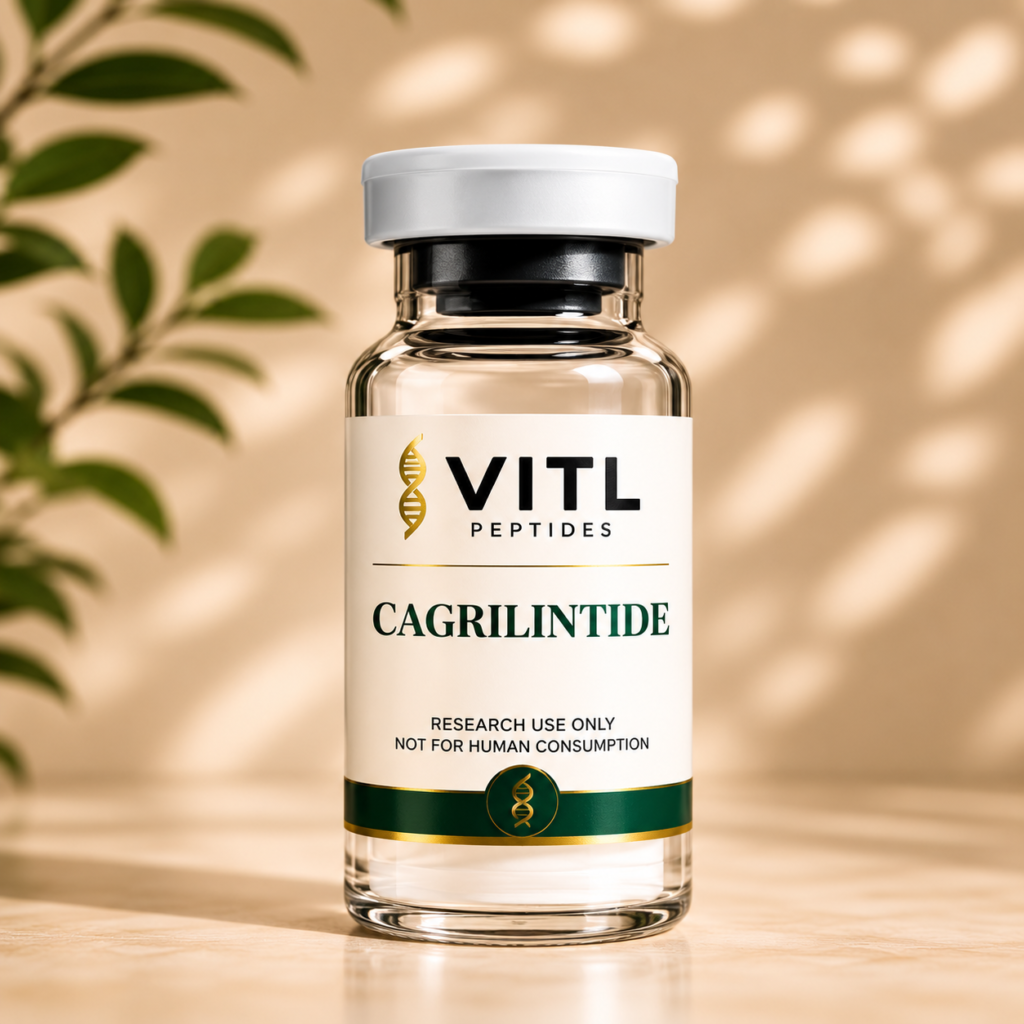
Cagrilintide is a long-acting amylin analogue being investigated for its potential role in appetite regulation, body-weight management, and metabolic health. Researchers are studying how this peptide interacts with amylin-related signaling pathways and how its effects may differ from those of established metabolic medicines. Interest has also increased in combination research involving cagrilintide and semaglutide, which target different biological systems.
For those researching the compound’s identity and specifications, the Cagrilintide peptide product page provides a starting point for reviewing product information. However, commercial research-compound listings should not be confused with approved medicines or evidence of clinical suitability.
Understanding cagrilintide requires examining its biological rationale, clinical development, safety considerations, and the quality documentation needed to evaluate research materials.
What Is Cagrilintide?
Cagrilintide is a synthetic, long-acting analogue of amylin, a hormone naturally released by pancreatic beta cells alongside insulin. Its development reflects scientific interest in amylin signaling as a way to investigate appetite, satiety, food intake, and body-weight regulation.
Unlike a conventional supplement, cagrilintide is an investigational peptide drug candidate. Its potential applications must be assessed through controlled research, and its regulatory status should be verified using current information from relevant health authorities.
Understanding Amylin and Its Biological Role
Amylin is involved in regulating how the body responds to food. It acts through receptor systems associated with the calcitonin receptor and receptor activity-modifying proteins. These signaling systems are found in tissues involved in appetite control and other physiological functions.
Amylin-related activity has been associated with increased satiety, reduced food intake, and changes in gastric emptying. These processes help researchers understand how hormonal signals coordinate feeding behavior and energy balance.
Amylin does not act independently of other metabolic signals. Its effects interact with broader physiological systems that include insulin signaling, gastrointestinal activity, and neural pathways involved in appetite.
Cagrilintide as a Long-Acting Amylin Analogue
Cagrilintide was developed to provide prolonged amylin-like activity compared with the naturally occurring hormone. Its long-acting properties make it suitable for investigation as a potential treatment administered at extended intervals under a controlled clinical protocol.
Researchers examine its pharmacokinetics, receptor activity, tolerability, and effects on appetite-related outcomes. These measurements help determine how the compound behaves in the body and whether its biological effects can be translated into a useful treatment.
Longer duration of action alone does not establish clinical effectiveness. The compound must also demonstrate an acceptable safety profile and meaningful benefits in appropriately designed studies.
Why Researchers Study Amylin-Related Signaling
Amylin-related signaling provides an additional pathway for investigating appetite and metabolic regulation. Researchers are interested in whether activating this pathway can complement existing approaches that influence glucose regulation, food intake, and body weight.
The research also helps clarify how different hormonal signals contribute to satiety. Understanding these mechanisms may support the development of treatments with distinct or complementary pharmacological effects.
How Is Cagrilintide Investigated in Metabolic Research?
Cagrilintide research examines both biological mechanisms and measurable outcomes. Laboratory investigations can explore receptor activity, while human clinical trials assess pharmacological effects, tolerability, and changes in defined health endpoints.
These evidence types answer different questions. Mechanistic findings can explain why a compound deserves further study, but clinical research is needed to establish whether the observed effects are meaningful and reproducible in people.
Amylin-Related Pathways and Appetite Regulation
Researchers investigate how cagrilintide activates amylin-associated receptor systems and influences signaling involved in appetite. These pathways may affect the brain’s processing of hunger and satiety signals, contributing to changes in food intake.
Research protocols may examine appetite ratings, eating behavior, energy intake, and changes in body weight. The interpretation of these outcomes depends on study design, participant characteristics, treatment duration, and comparison groups.
Changes in appetite-related measures do not automatically demonstrate improvements in every aspect of metabolic health. Each proposed effect requires appropriate evidence.
Research on Gastric Emptying and Satiety
Gastric emptying refers to the movement of stomach contents into the small intestine. Amylin-related signaling can influence this process, which is one reason researchers study it alongside satiety and appetite.
When evaluating cagrilintide, investigators may consider gastrointestinal responses, feelings of fullness, and changes in food intake. These effects are relevant to understanding the compound’s overall pharmacological profile.
However, responses may vary across individuals and treatment conditions. Gastric emptying, appetite, body weight, and blood glucose are separate measures, so evidence for one should not be treated as proof of benefits in all the others.
Understanding the Difference Between Proposed Mechanisms and Established Outcomes
A proposed mechanism describes how a compound might produce a biological effect. An established clinical outcome requires evidence from appropriately designed human studies.
This distinction is important when reviewing peptide research. Findings from laboratory models, early-stage trials, and later-stage clinical studies have different levels of evidentiary strength.
Claims about long-term health benefits, suitability for particular populations, or effectiveness outside studied conditions should not be inferred from a mechanism alone.
What Does Clinical Research Say About Cagrilintide?
Cagrilintide has progressed into advanced clinical development for weight management. Its clinical research includes evaluation as a standalone compound and as part of a combination with semaglutide. The results must be interpreted according to the particular treatment, dose, population, and endpoint investigated.
Reviewing the Stages of Clinical Development
Clinical development generally progresses from early studies of safety and pharmacokinetics to larger trials assessing efficacy and longer-term outcomes. Phase 1 research typically emphasizes initial safety and how a compound behaves in the body. Phase 2 studies investigate dose selection and preliminary efficacy, while Phase 3 trials provide broader evidence for potential regulatory decisions.
Cagrilintide has entered Phase 3 development as a standalone candidate, while the combination product CagriSema has undergone extensive Phase 3 evaluation. The progress of one program does not mean that every formulation or use of the compound has been approved.
Understanding Clinical Trial Endpoints and Study Populations
Clinical trials may evaluate body-weight changes, blood glucose measures, adverse events, treatment discontinuation, and other predefined outcomes. Researchers also examine how results differ according to baseline health, existing conditions, and other treatments.
The statistical method used to analyze results matters. Some analyses estimate outcomes under conditions where participants remain on treatment, while others assess outcomes regardless of treatment discontinuation or additional medication. These approaches can produce different estimates.
Study duration and participant selection also influence how broadly findings can be applied.
Interpreting Results Without Overgeneralizing Findings
Clinical results should be reviewed alongside trial design, comparator treatments, follow-up periods, and adverse-event data. A positive result for a particular endpoint does not establish that every expected benefit has been demonstrated.
For the latest development information, readers can review Novo Nordisk’s official clinical announcements. Regulatory decisions and trial findings may change over time, so current information is more useful than relying on older summaries or promotional claims.
What Is the Relationship Between Cagrilintide and Semaglutide?
Cagrilintide and semaglutide are being studied together because they influence different but potentially complementary biological pathways. The combination is known as CagriSema and remains subject to its own clinical and regulatory assessment.
Understanding Their Different Pharmacological Targets
Cagrilintide is an amylin analogue that acts on amylin-related receptor systems. Semaglutide is a glucagon-like peptide-1, or GLP-1, receptor agonist. GLP-1 signaling contributes to glucose regulation, appetite-related responses, and gastrointestinal functions.
Although both compounds may affect appetite and body weight, their primary pharmacological targets differ. This distinction provides the scientific basis for investigating whether their combined effects can offer additional benefits.
The Scientific Rationale Behind Combination Research
Combination research investigates whether complementary mechanisms can improve treatment outcomes compared with either compound alone. Studies may compare the combination with individual components and placebo, using predefined measures such as body weight, glycemic control, and tolerability.
The rationale is scientifically plausible, but the magnitude and consistency of any additional benefit must be established through clinical evidence.
Why Combination Findings Must Be Evaluated Separately
Evidence from CagriSema trials cannot automatically be applied to cagrilintide alone. The combination contains two active compounds, so its outcomes reflect the treatment regimen studied rather than the isolated effects of one ingredient.
Doses, formulations, treatment schedules, and participant characteristics also affect the interpretation of results. A combination’s clinical profile must therefore be assessed independently.
Distinguishing an Investigational Combination From an Approved Product
CagriSema is the investigational fixed-dose combination of cagrilintide and semaglutide. Although its development has advanced through Phase 3 trials and regulatory submission, that does not make every cagrilintide product or independently prepared combination an approved medicine.
Readers should verify the current status with the relevant regulator. Approval in one jurisdiction, if granted, does not automatically establish approval elsewhere.
What Are the Safety and Regulatory Considerations?
Safety and regulatory review are essential when evaluating investigational peptides. Clinical findings apply to the formulations, doses, populations, and conditions studied, not to every product sold under a similar name.
Understanding Investigational Status and Approval Requirements
A compound may undergo extensive research without receiving marketing authorization. Regulatory approval generally requires assessment of clinical evidence, manufacturing quality, safety, efficacy, labeling, and other applicable requirements.
As of October 2026, cagrilintide remains in clinical development as a standalone candidate, while CagriSema has been submitted for regulatory review in the United States. Readers should check official regulator announcements for the latest decision and confirm the status in their own country.
Why Clinical Trial Results Do Not Establish the Safety of Unapproved Products
Research-grade materials may not have undergone the same review, manufacturing controls, or clinical testing required for authorized medicines. A product’s advertised identity does not establish its purity, sterility, dose accuracy, or suitability for human use.
Research results also cannot establish the safety of products with uncertain composition or handling histories. Products marketed for research should not be assumed suitable for self-administration or medical treatment.
The Importance of Medical Oversight for Authorized Treatments
Authorized treatments require appropriate medical assessment and monitoring. Healthcare professionals can evaluate contraindications, interactions, relevant medical history, and potential adverse effects according to the approved product information.
Investigational compounds should only be used within appropriately authorized research arrangements. Product descriptions and online discussions are not substitutes for clinical advice.
What Quality Documentation Matters for Research Compounds?
Quality documentation helps researchers determine whether a material meets its stated specifications. It is especially important for peptides, where identity, purity, stability, and storage conditions can influence experimental reliability.
For research resources and product information, Vitl Peptides provides a website to review available listings. A listing alone, however, should not be treated as independent verification of a product’s quality or authorization for human use.
Confirming Compound Identity and Specifications
Documentation should identify the compound clearly and provide relevant specifications, including sequence or identity information where applicable, stated quantity, batch identification, and storage requirements.
Researchers should check whether the supplied documentation corresponds to the exact batch being evaluated. Generic certificates that cannot be linked to a specific lot provide limited assurance about the material received.
Reviewing Analytical Testing and Batch Records
Analytical methods such as high-performance liquid chromatography and mass spectrometry can help assess purity and molecular identity. These methods provide different kinds of information, and neither should be interpreted beyond what the actual test demonstrates.
Useful records include batch-specific analytical results, test methods, acceptance criteria, and details identifying the laboratory responsible for testing. Purity results alone do not establish sterility, clinical safety, or regulatory approval.
Understanding Stability and Handling Documentation
Peptides may be sensitive to temperature, moisture, light, and other environmental conditions. Stability information helps researchers understand the conditions under which a material is expected to retain its specified characteristics.
Handling documentation should identify storage requirements, relevant precautions, and any available stability data. Researchers should not assume that a compound remains suitable for testing after inappropriate storage or beyond its supported stability period.
Frequently Asked Questions
What Is Cagrilintide?
Cagrilintide is a long-acting synthetic analogue of amylin being investigated for its effects on appetite, satiety, and body-weight regulation. Its clinical development and regulatory status should be checked through current official sources.
What Is Amylin?
Amylin is a hormone released by pancreatic beta cells alongside insulin. It contributes to physiological processes related to satiety, food intake, and gastric emptying through amylin-associated receptor systems.
How Does Cagrilintide Differ From Semaglutide?
Cagrilintide targets amylin-related signaling, whereas semaglutide activates GLP-1 receptors. Both are studied for effects relevant to appetite and metabolic regulation, but they act through different primary pharmacological targets.
What Is CagriSema?
CagriSema is an investigational fixed-dose combination of cagrilintide and semaglutide. Researchers are evaluating whether the two complementary mechanisms can improve outcomes for weight management and type 2 diabetes. Its regulatory status should be confirmed through official announcements.
What Should Readers Check About Cagrilintide’s Current Regulatory Status?
Check the relevant national regulator’s website and official clinical-development announcements. Distinguish standalone cagrilintide from CagriSema, and verify whether a specific product, formulation, and intended use are authorized in the jurisdiction concerned.
Conclusion
Cagrilintide research expands scientific understanding of amylin signaling and its potential role in appetite and metabolic regulation. Clinical development has progressed beyond early-stage investigation, with ongoing research into both standalone cagrilintide and the combination of cagrilintide with semaglutide.
Nevertheless, biological rationale, clinical evidence, product quality, and regulatory authorization are separate considerations. Reliable evaluation requires careful interpretation of trial endpoints, a clear understanding of the compound being studied, and batch-specific analytical documentation where research materials are concerned.
For additional company information, readers can visit the About us page. Research-related information should always be considered separately from evidence of medical approval, and investigational compounds should not be treated as substitutes for authorized treatments or professional medical guidance.